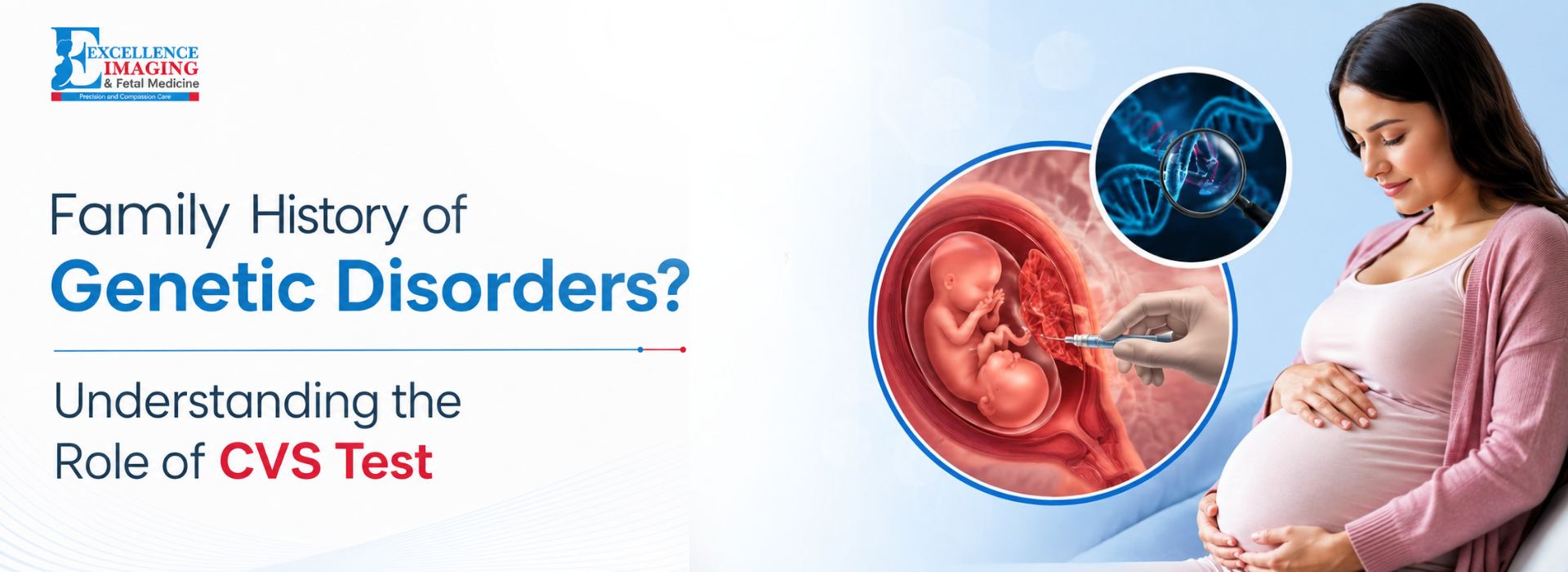
A family history of genetic disorders can make every pregnancy milestone feel a little more uncertain. Will my baby inherit the same condition that runs in our family?
This is exactly why we offer CVS genetic testing to expecting parents with family concerns. It offers a clear path to early answers about your baby's health during pregnancy. As fetal medicine specialists who have supported many families through these decisions, we see how a family history of genetic disorders brings unique worries. This test, known as Chorionic Villus Sampling, provides reliable diagnostic information when it matters most — in the first trimester.
At Excellence Imaging and Fetal Medicine, we perform these procedures with expert ultrasound guidance, compassion, and full transparency so you feel supported every step of the way.
What Is CVS Genetic Testing During Pregnancy?
People often ask, "What is CVS testing for?"
CVS genetic testing is a diagnostic prenatal test that examines cells from the placenta to provide detailed information about your baby's chromosomes and genes. The placenta contains the same genetic material as the developing baby, making it an excellent source for testing.
These tests go beyond routine screenings by giving definitive answers rather than just risk estimates. They are particularly helpful when parents want clarity about potential inherited conditions.
- Performed under continuous ultrasound guidance for precision
- Involves a small tissue sample that does not harm the pregnancy
- Focuses on families facing specific genetic questions
Understanding this helps remove much of the mystery and anxiety surrounding the process.
Who Should Consider CVS? Family History and Risks
Many parents come to us after learning about genetic conditions in their family. If you or your partner have a family history of disorders like Down syndrome, cystic fibrosis, or other chromosomal issues, CVS can provide the insights needed for informed planning.
Key situations where CVS is often discussed:
- Family history of genetic or chromosomal conditions
- Previous child with a known genetic disorder
- Advanced maternal age (35 or older)
- Abnormal results from first-trimester screening tests
- Carrier status for specific inherited diseases
We always discuss your personal situation thoroughly. The goal is never to create worry but to support you with knowledge and options.
The Chorionic Villus Sampling Procedure (CVS): Step-by-Step
The test is done as an outpatient procedure and usually takes 30 to 45 minutes.
What happens during CVS:
- We begin with a detailed ultrasound to confirm your baby's heartbeat and locate the placenta.
- Two gentle approaches are possible:
- Transcervical: A thin, flexible tube is guided through the cervix.
- Transabdominal: A thin needle is inserted through the abdomen.
- Ultrasound ensures every movement is precise and safe.
- Only a tiny sample of placental tissue is collected.
Most women feel only mild cramping, similar to period discomfort. You can usually return to normal activities the same day, though we suggest resting.
Role of CVS Test in Managing Genetic Concerns
The role of CVS test in pregnancy goes far beyond simple diagnosis. It serves as a vital tool that helps families prepare emotionally, medically, and practically when facing potential genetic challenges.
This role includes:
- Early Guidance — Providing answers in the first trimester so you have time to understand any diagnosis and explore all options.
- Accurate Information — Delivering reliable results that help specialists create a tailored care plan for your pregnancy.
- Family Support — Enabling better communication with your healthcare team and connecting you with appropriate support resources.
- Peace of Mind — For many families, normal results bring tremendous relief and allow focus on enjoying the rest of the pregnancy.
This structured approach minimizes uncertainty and supports better outcomes.
Key Benefits of CVS Genetic Testing During Pregnancy
Parents often ask why they might choose this test. Here are the main advantages that make CVS genetic testing during pregnancy valuable for many families:
- Early Detection — Answers come weeks earlier than other diagnostic options, giving you more time to prepare.
- High Accuracy — The test is approximately 99% accurate for detecting common chromosomal conditions.
- Informed Decision Making — Clear results help you work with specialists to plan the best care for your baby.
- Reduced Anxiety — Knowing the situation early often brings relief and allows focused preparation.
- Better Pregnancy Management — If a condition is identified, your care team can arrange specialized monitoring or interventions.
- Family Planning Insights — Results can provide useful information for future pregnancies.
- Minimal Discomfort — Most women report only mild, temporary discomfort during the brief procedure.
- Expert Guidance — Performed at centers like Excellence Imaging with experienced fetal medicine specialists.
These benefits help turn uncertainty into actionable knowledge.
What Can CVS Detect: Focus on Common Genetic Disorders
CVS excels at identifying chromosomal abnormalities and many single-gene disorders, especially when there is a family history.
Common conditions it can help diagnose include:
- Down syndrome (Trisomy 21)
- Edwards syndrome and Patau syndrome
- Cystic fibrosis, sickle cell disease, and other inherited metabolic conditions
- Certain sex-linked genetic disorders
The test is tailored based on your specific family history and screening results. Our team discusses exactly what will be analyzed in your case.
CVS Test Pregnancy Weeks: Timing and Why It Matters
The ideal window for CVS test pregnancy weeks is between 10 and 13 weeks of gestation. This early timing is one of the biggest advantages of choosing CVS.
Why this timing helps families:
- Allows results well before the end of the first trimester
- Provides more time for additional consultations if needed
- Enables earlier planning for specialized care
- Fits naturally after common first-trimester screenings
At Excellence Imaging, we confirm your exact gestational age with ultrasound before proceeding.
Chorionic Villus Sampling Results: What to Expect
After the procedure, the sample is sent to a specialized genetics lab. Chorionic villus sampling results typically include preliminary findings within a few days and a complete analysis within 1 to 2 weeks.
Understanding your results:
- Normal findings offer reassurance and let you focus on a healthy pregnancy journey.
- Any identified conditions are explained clearly with full support from our team.
- We review every report together in plain, parent-friendly language.
- Further testing or specialist referrals are arranged as needed.
You are never left to interpret complex information alone.
CVS vs Amniocentesis: Understanding the Options
Families often compare amniocentesis and chorionic villus sampling when considering diagnostic testing.
Main differences:
- Timing: CVS at 10–13 weeks vs. amniocentesis usually at 15–20 weeks
- Sample: Placental tissue (CVS) vs. amniotic fluid
- Detection: Both identify chromosomal and genetic issues; amniocentesis also checks for some neural tube defects
- Procedure feel: Both use ultrasound guidance and are well-tolerated
We help you choose the option that best fits your gestational age, medical needs, and personal preferences.
The Excellence Imaging Way
A family history of genetic disorders does not have to overshadow your pregnancy with fear. CVS testing provides a reliable, early window into your baby's health, empowering you with knowledge and time to prepare.
At Excellence Imaging in Janakpuri, our focus remains on safety, accuracy, and compassionate care. We are here to answer your questions, address your concerns, and support your family's unique journey.
Book your CVS genetic testing consultation at Excellence Imaging today.
Frequently Asked Questions (FAQs)
Is CVS genetic testing during pregnancy safe for my baby?
Yes, CVS is considered a safe procedure when performed by experienced specialists. The risk of miscarriage is low, approximately 0.5% to 1%. At Excellence Imaging, we use continuous ultrasound guidance and take every precaution to ensure your baby's safety. We discuss all risks and benefits with you in detail before the test.
How is the chorionic villus sampling procedure different from amniocentesis?
The main differences are timing and the sample collected. CVS is done earlier (10–13 weeks) using a small sample from the placenta, while amniocentesis is usually performed after 15 weeks using amniotic fluid. Both are diagnostic tests with high accuracy. Your doctor will help you choose the best option based on your pregnancy stage and medical needs.
When will I get my CVS test results?
Preliminary results for common chromosomal conditions are often available within 2 to 3 days. A complete report usually takes 7 to 14 days. Our team explains the results clearly in simple language and guides you on the next steps, whether the results are normal or need further attention.
Who should consider CVS genetic testing during pregnancy?
CVS is recommended if you have a family history of genetic disorders, advanced maternal age (35+), abnormal NIPT or first-trimester screening results, or if a previous child had a chromosomal condition. It is especially helpful for parents who want early, definitive answers.
Does insurance cover the CVS test pregnancy cost?
Many insurance plans cover CVS when there is a medical indication such as family history or abnormal screenings. The exact cost depends on your insurance and the type of genetic analysis needed. Our team at Excellence Imaging will help you check your coverage and discuss all financial aspects transparently during your consultation.