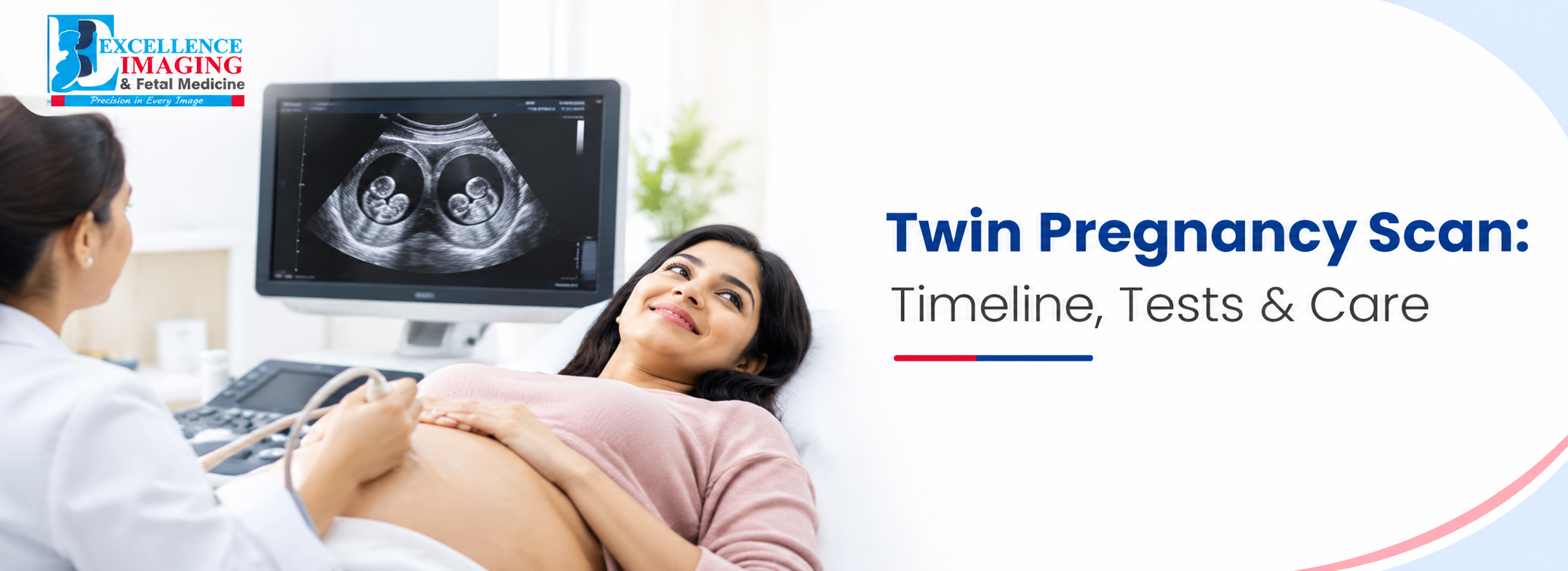
A twin pregnancy brings double the excitement, but it also needs closer monitoring from the
earliest weeks. A twin pregnancy scan
helps confirm the number of embryos, check each baby's heartbeat, estimate the due date,
identify placental sharing, and monitor growth throughout pregnancy. Unlike a singleton
pregnancy ultrasound, every scan assesses two babies individually as well as the pregnancy
environment they share.
At Excellence Imaging, twin pregnancy ultrasound scans are performed with careful attention to
fetal growth, placental position, amniotic fluid, cervical length, and Doppler blood flow when
required. The aim is to give expecting parents clear answers at every stage of pregnancy.
First Twin Scan: 5 to 10 Weeks
A pregnancy test may confirm pregnancy, but an ultrasound scan during pregnancy
confirms what is happening inside the uterus. A twin pregnancy scan at 5 weeks may show one or
two gestational sacs, although it can sometimes be too early to see clear details. A repeat scan
may be advised if the results are not yet conclusive.
A twin pregnancy scan at 6 weeks or 7 weeks can usually confirm the number of
embryos and check for individual heartbeats. A twin pregnancy scan at 8 weeks gives a clearer
view of fetal development and helps the doctor calculate the estimated due date pregnancy more
accurately.
This early scan is often called a viability scan or dating scan. It can assess:
- Number of gestational sacs and embryos.
- Location of the pregnancy inside the uterus.
- Cardiac activity or heartbeat for each baby.
- Pregnancy dating based on fetal measurements.
- Early signs of a multiple pregnancy.
- Possible concerns such as ectopic pregnancy.
A scan at 4 weeks is generally very early. At this stage, a gestational ultrasound may not yet show enough detail, particularly if pregnancy dates are uncertain. This does not always indicate a problem; the doctor may recommend another ultrasound test after one or two weeks.
NT Scan and Placental Assessment
The first trimester is especially important in twin pregnancy care. Between 11 and 13 weeks plus
6 days, an NT scan in pregnancy is commonly advised. Also known as a pregnancy nuchal scan, it
measures the fluid behind the neck of each baby as part of first-trimester screening.
This appointment also helps determine chorionicity, meaning whether the babies share one
placenta or have separate placentas. This matters because the scan schedule and pregnancy care
differ according to the type of twin pregnancy.
- Dichorionic diamniotic twins: Usually have two placentas and two amniotic sacs.
- Monochorionic diamniotic twins: Share one placenta but have separate sacs.
- Monochorionic monoamniotic twins: Share both one placenta and one amniotic sac and need highly specialised monitoring.
Fraternal twins are commonly dichorionic, while identical twins may share a placenta. However,
ultrasound findings, rather than assumptions, are used to confirm the type of twin pregnancy.
Your doctor may also discuss blood testing for pregnancy, NT screening, or non-invasive prenatal
testing. These are screening tools, not final diagnostic tests. If a result indicates increased
risk, a fetal medicine specialist may advise genetic counselling or additional prenatal testing.
Anomaly Scan and Growth Scans
The anomaly scan, also called the anatomy scan, is usually performed between 18 and 22 pregnancy
weeks. It is one of the most detailed scans during pregnancy because both babies must be assessed
separately.
During this ultrasound scan, the radiologist or fetal medicine specialist checks the brain,
spine, heart, kidneys, stomach, limbs, facial structures, umbilical cord, placenta position, and
amniotic fluid. Cervical length in pregnancy may also be evaluated because twin pregnancies have
a higher chance of preterm birth.
After the anatomy scan, regular growth scans help track whether both babies are growing at an
expected rate. A growth scan checks:
- Estimated fetal weight for each baby.
- Growth difference between the twins.
- Amniotic fluid around each baby.
- Placenta position and cord insertion.
- Fetal heartbeat and movement.
- Cervical length, where clinically needed.
For uncomplicated dichorionic twins, scans are often planned at regular intervals. Monochorionic twins generally require more frequent scans because a shared placenta can create additional risks. The exact schedule should always be personalised by the treating obstetrician or fetal medicine team.
Doppler Scan in Twin Pregnancy
A pregnancy Doppler or Doppler scan in pregnancy measures blood flow in important fetal blood
vessels, including the umbilical artery and middle cerebral artery. It is usually recommended
when there is a growth concern, fluid imbalance, blood-flow concern, or suspected pregnancy
complication.
Doppler assessment is particularly important in monochorionic pregnancies. It can help doctors
monitor complications such as twin-to-twin transfusion syndrome, selective fetal growth
restriction, and twin anaemia-polycythaemia sequence.
Twin-to-twin transfusion syndrome occurs when blood flow through a shared placenta becomes
unbalanced. One twin may receive too little blood while the other receives too much. Regular
scans can identify warning signs such as a major difference in amniotic fluid, unequal fetal
growth, or changes in Doppler flow.
A twin pregnancy scan report should be reviewed with your obstetrician. Rather than comparing one
number online, ask about each baby's growth, placenta, fluid level, Doppler findings, and
recommended timing for the next scan.
Twin Pregnancy Scan FAQs
When is the first scan during twin pregnancy?
A first scan during pregnancy is often performed between 6 and 10 weeks. A twin pregnancy scan at 6 weeks may detect two embryos and heartbeats, though timing can vary depending on ovulation dates.
How many scans are needed in twin pregnancy?
Twin pregnancies usually need more scans throughout pregnancy than singleton pregnancies. The number depends on chorionicity, fetal growth, maternal health, and whether any complications are identified.
Is a twin pregnancy high risk?
A multiple pregnancy needs closer observation, but every pregnancy is different. Early identification of placental type, regular growth scans, and timely pregnancy Doppler testing support safer pregnancy care.
What should a twin pregnancy scan report include?
It commonly includes fetal number, heartbeats, gestational age, estimated due date, chorionicity,
growth measurements, amniotic fluid, placenta position, and Doppler findings when performed.
You may contact
Excellence Imaging and Fetal Medicine
to enquire about the appropriate appointment, examination details and current price of the
required scan.