Choosing the best NIPT test centre in Delhi
is about more than getting a blood sample collected. Prenatal genetic screening can raise
important questions about whether the test is appropriate for the pregnancy, what it screens
for, and what should happen after the report.
At Excellence Imaging & Fetal Medicine, NIPT is approached within a wider fetal medicine and
genetic care setting. The centre brings together specialist fetal medicine, genetic counselling,
advanced prenatal diagnostics and patient focused care, helping families understand the
screening process rather than treating NIPT as just another blood test.
NIPT Testing at Excellence Imaging & Fetal Medicine
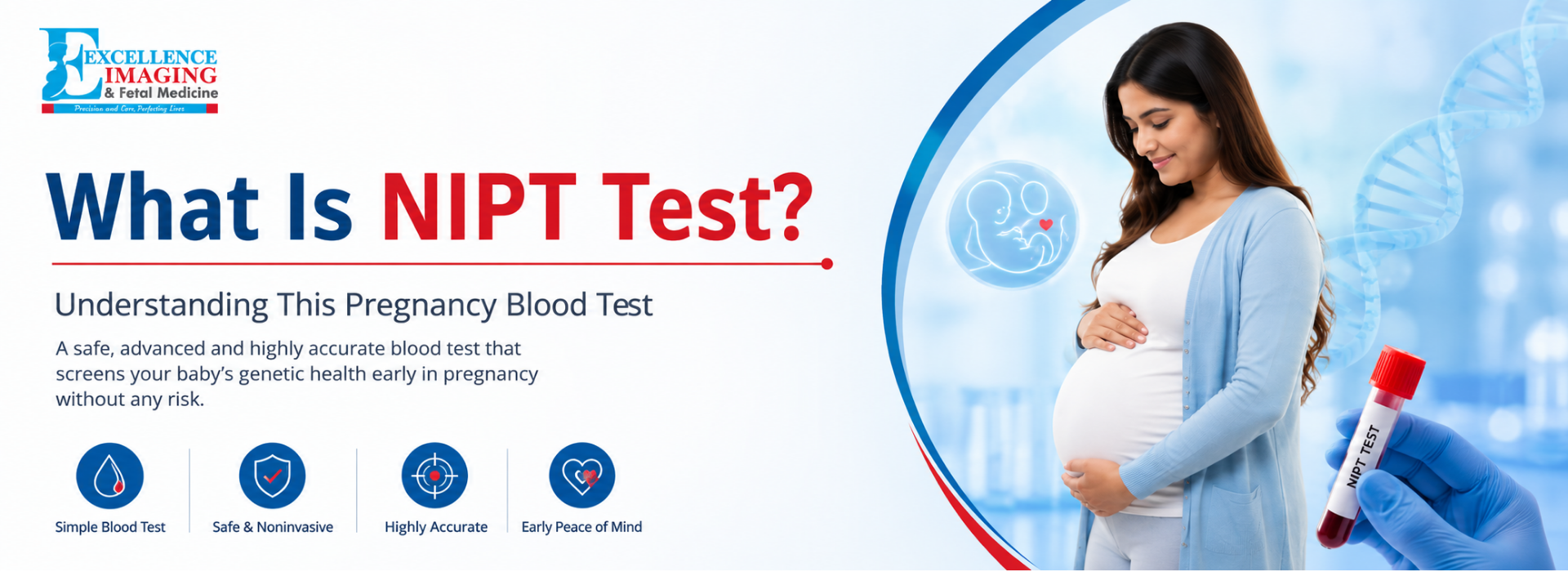
Non Invasive Prenatal Testing, or NIPT, is a prenatal screening test performed using a maternal
blood sample. It analyses cell free DNA to assess the likelihood of certain chromosomal
conditions.
NIPT commonly screens for conditions associated with trisomy 21, trisomy 18 and trisomy 13,
including Down syndrome, Edwards syndrome and Patau syndrome. The exact conditions covered
depend on the screening panel selected.
It is important to understand that NIPT is a screening test, not a diagnostic test.
A low risk result reduces the likelihood of the conditions screened for, while a high risk
result indicates an increased likelihood. A high risk screening result may require diagnostic
testing for confirmation.
At Excellence, the value of NIPT lies not only in the screening itself but also in having access
to specialists who can place the result in the context of the pregnancy.
Why Excellence for NIPT in Delhi?
Excellence Imaging & Fetal Medicine is a specialised centre combining advanced diagnostics
with fetal medicine. Its team includes Dr. Sharad Gupta, Senior Consultant and Director of
Radiology & Fetal Medicine, and Dr. Shruti Agarwal, Senior Consultant and Director of Fetal
Medicine & Genetic Counseling. Both have specialised training in fetal medicine and
genetics, with FMF UK certification.
This expertise becomes particularly relevant when prenatal screening needs to be understood
alongside the pregnancy history, ultrasound findings or other risk factors.
Genetic Counselling for Better Understanding
Genetic counselling is an important part of prenatal genetic care. At Excellence, counselling
helps families understand genetic risks,
chromosomal abnormalities
and the role of specialised tests using information such as family history and medical reports.
For NIPT, this can help patients understand what the screening can tell them, what it cannot
confirm, and why additional assessment may sometimes be recommended.
Advanced Fetal and Prenatal Diagnostics
NIPT does not replace other aspects of fetal assessment. Depending on the pregnancy and clinical
findings, a specialist may recommend additional imaging or diagnostic procedures.
Excellence provides advanced ultrasound, fetal echocardiography, genetic counselling and fetal
interventions including chorionic villus sampling and amniocentesis.
This broader fetal medicine setup allows prenatal concerns to be evaluated through the
appropriate combination of screening, imaging and diagnostic care.
Specialist Guidance Throughout the Visit
At Excellence Imaging and
Fetal Medicine, the patient journey begins with a detailed consultation to understand the
patient's history, concerns and needs. The specialists then guide patients towards the services
appropriate for their situation and explain the process clearly.
This approach is particularly valuable for prenatal genetic screening, where understanding the
result can be as important as undergoing the test.
How NIPT Testing Is Done
NIPT is performed through a maternal blood sample, making the sample collection itself
non-invasive. The collected sample undergoes laboratory analysis according to the selected
screening test, after which a report is provided.
At Excellence, the NIPT journey can be understood as:
Specialist consultation → Maternal blood sample → Laboratory analysis → NIPT report → Specialist guidance
The centre's existing care approach places emphasis on explaining each step, answering patient
questions and providing guidance with the results.
The appropriate timing for NIPT should be discussed with the treating specialist. NIPT can
generally be performed from around 10 weeks of pregnancy, although the appropriate timing may
depend on the pregnancy and the specific test being considered.
NIPT Test Price in Delhi
The NIPT test price in Delhi can differ depending on the screening panel and
the conditions included in the test.
Rather than presenting an outdated fixed price, patients should contact Excellence Imaging
& Fetal Medicine for the current NIPT options and charges. The cost may depend on the
selected screening panel, laboratory requirements and any additional clinical services
recommended as part of the pregnancy assessment.
Care Beyond the NIPT Report
A screening report should always be understood in the context of the pregnancy. A high risk
result does not by itself confirm a chromosomal condition. Depending on the clinical situation,
further diagnostic testing may be considered.
Excellence provides access to fetal medicine specialists, genetic counselling and procedures
such as CVS and amniocentesis when diagnostic assessment is clinically indicated.
The centre also maintains a strong focus on accurate and timely reporting, quality control,
patient safety, hygiene and patient centred support.
Book NIPT Test at Excellence Imaging, Delhi
For families looking for an
NIPT Test in Delhi,
Excellence Imaging & Fetal Medicine offers prenatal genetic care within a specialised fetal
medicine environment.
With experienced fetal medicine specialists, genetic counselling, advanced prenatal diagnostics
and a patient focused approach, the centre provides support that extends beyond the blood test
itself.
To discuss the appropriate NIPT option, current NIPT test price in Delhi, and
appointment process, contact Excellence Imaging & Fetal Medicine at its Janak Puri centre.