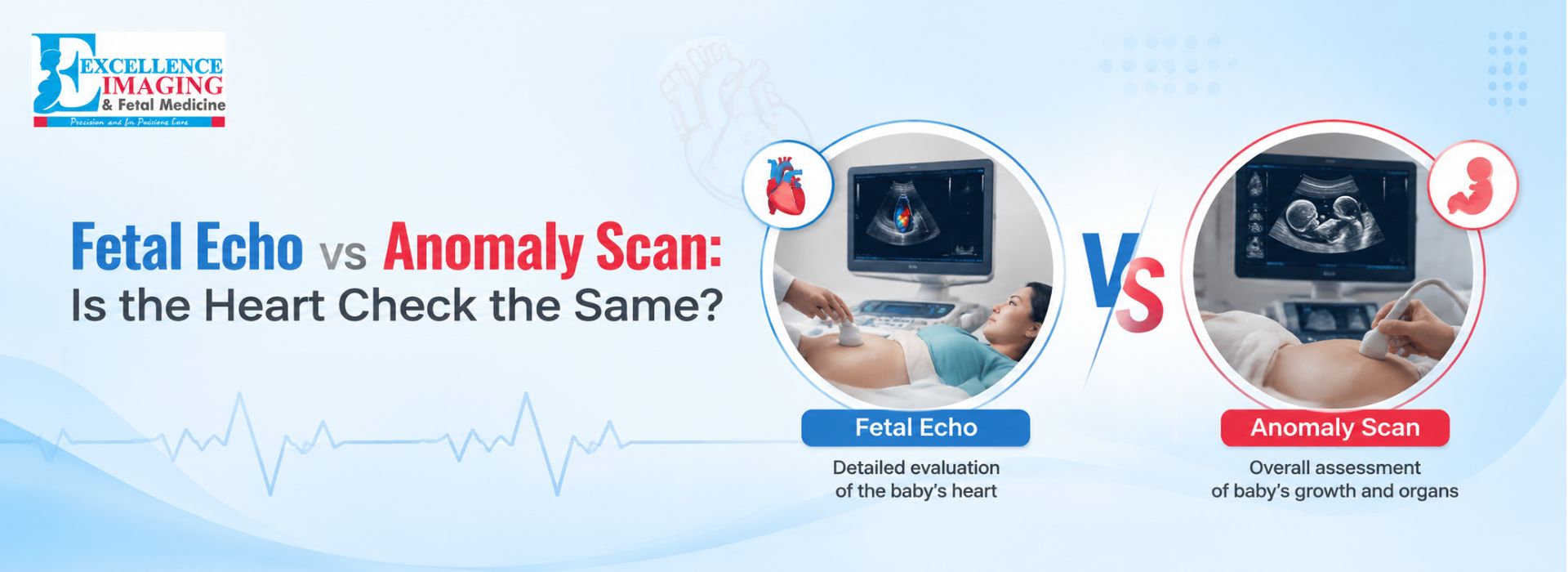
No. The heart check included in an anomaly scan is not the same as a detailed
fetal echocardiography examination.
An anomaly scan reviews the baby's overall anatomy, growth and development. It also includes
routine screening views of the fetal heart. A fetal echo, on the other hand, is a dedicated
examination of the baby's heart, including its chambers, valves, major blood vessels, rhythm
and blood flow.
Both scans may be performed during the same stage of pregnancy, but they answer different
medical questions. Fetal echo and anomaly scan should therefore be understood
as complementary examinations, not alternative names for the same test.
Fetal Echo and Anomaly Scan: Quick Comparison
| Feature | Anomaly scan | Fetal echo |
|---|---|---|
| Main purpose | Examines the baby's overall anatomy and development | Provides a detailed assessment of the baby's heart |
| Common name | Anatomy scan, level 2 scan or 20-week scan | Fetal echocardiography or fetal heart scan |
| Organs examined | Brain, face, spine, chest, abdomen, limbs, kidneys, placenta and heart | Heart chambers, valves, outflow tracts, arches, major vessels, rhythm and blood flow |
| Heart assessment | Routine cardiac screening views | Comprehensive cardiac examination |
| Typical timing | Usually around 18–22 weeks | Usually around 18–22 weeks |
| Who usually undergoes it? | Commonly recommended as part of pregnancy screening | Recommended when there is a clinical indication or suspected cardiac concern |
| Report focus | Overall fetal anatomy and development | Detailed fetal cardiac findings |
| Can it replace the other test? | No | No |
The most important difference between fetal echo and anomaly scan is the scope of the examination. An anomaly scan looks at the whole baby and performs a basic heart assessment; fetal echocardiography concentrates on the heart and examines it in greater depth.
Anomaly Scan vs Fetal Echo: What Does Each Scan Examine?
What Does an Anomaly Scan Check?
An anomaly scan
is a detailed second-trimester ultrasound examination. It assesses whether the baby's major
organs and physical structures are developing as expected.
The examination may include assessment of:
- Brain and skull.
- Face and upper lip.
- Spine.
- Chest and lungs.
- Stomach and bowel.
- Kidneys and urinary bladder.
- Arms, legs, hands and feet.
- Placenta, umbilical cord and amniotic fluid.
- Fetal growth and general development.
- Basic views of the fetal heart.
The heart is only one part of the anomaly scan. Since the examination covers several organs and systems, the cardiac assessment is a screening component rather than a complete fetal heart evaluation.
What Does a Fetal Echo Check?
A fetal echo
is a specialised ultrasound examination focused on the developing heart. It uses targeted
cardiac views to assess the heart's structure, connections and function.
The examination may include assessment of:
- Position and axis of the heart.
- Right and left atria.
- Right and left ventricles.
- Septum between the chambers.
- Tricuspid and mitral valves.
- Pulmonary and aortic valves.
- Right and left ventricular outflow tracts.
- Aorta and pulmonary artery.
- Aortic and ductal arches.
- Major veins and arteries.
- Heart rate and rhythm.
- Cardiac movement and blood flow.
This is why a fetal echo scan report provides more specific information about the baby's heart than the cardiac section of a routine anomaly scan.
What Is the Heart Check in an Anomaly Scan?
During an anomaly scan, the doctor generally obtains a four-chamber view of the fetal heart and,
where possible, views of the major vessels leaving the heart. These views form an important part
of fetal heart assessment during an anomaly scan
and help screen for several structural cardiac abnormalities.
However, the quality of the heart assessment may depend on:
- The baby's position.
- Fetal movement during the scan.
- Gestational age.
- Maternal body habitus.
- Amniotic fluid volume.
- The clarity of the ultrasound images.
- Whether the required cardiac views can be obtained.
A routine anomaly scan may therefore identify a possible heart problem, but it may not provide enough information to fully characterise that finding. When the heart views are incomplete, suspicious or technically limited, a separate fetal echocardiography examination may be recommended.
How Is Fetal Echo Different From This Heart Check?
The heart check during an anomaly scan is part of a wider anatomical assessment. The doctor
evaluates the fetal heart while also examining the brain, spine, face, abdomen, limbs, kidneys
and placenta.
A fetal echo is a focused cardiac examination. The specialist spends more time obtaining multiple
views of the heart and assessing how the chambers, valves, vessels and blood flow are connected.
The difference can be understood through this example:
Example: During an anomaly scan, the doctor may identify that the four chambers appear broadly normal. During a fetal echo, the specialist performs a more detailed assessment of the chambers, valves, outflow tracts, arches, rhythm and circulation.
This does not mean that one scan is "good" and the other is "bad." The anomaly scan is broader, while the fetal echo is more specialised.
Fetal Echo and Anomaly Scan: Are Both Scans Needed?
Sometimes, yes. An anomaly scan and fetal echo may both be recommended because they assess
different areas.
An anomaly scan may be advised as part of routine pregnancy screening. A fetal echo may be
recommended separately when the doctor needs a closer evaluation of the fetal heart.
A fetal echo may be advised when:
- The anomaly scan shows an abnormal or incomplete cardiac view.
- The four-chamber view appears unusual.
- The outflow-tract views cannot be assessed properly.
- The fetal heart rate or rhythm is abnormal.
- There is a previous child with congenital heart disease.
- A parent or close first-degree relative has congenital heart disease.
- The mother has pre-existing diabetes or another relevant medical condition.
- Increased nuchal translucency has been identified.
- A genetic or chromosomal condition is suspected.
- Another fetal abnormality is seen on ultrasound.
- The pregnancy has another recognised risk factor for congenital heart disease.
Guidelines commonly place detailed fetal cardiac assessment in the 18–22-week period and
recommend further evaluation when cardiac concerns or relevant risk factors are present.
The recommendation for fetal echo does not automatically mean that the baby has a heart defect.
In some cases, the test is advised because the earlier heart views were not clear enough or
because the pregnancy history warrants a more detailed examination.
Is Fetal Echo Necessary After a Normal Anomaly Scan?
Not for every pregnancy.
If the anomaly scan is normal, the cardiac views are satisfactory and there are no additional
risk factors, a separate fetal echo may not be required. However, a normal anomaly scan does not
always eliminate the need for fetal echocardiography.
Your doctor may still advise a fetal echo after an anomaly scan when:
- The routine cardiac views were incomplete.
- The baby's position made the heart difficult to assess.
- There is a family history of congenital heart disease.
- The mother has a medical condition associated with fetal heart abnormalities.
- Another ultrasound finding requires a detailed cardiac assessment.
- The referring doctor wants specialist confirmation.
The decision should be based on the findings and history of the individual pregnancy, not only on whether the anomaly scan was reported as normal.
Fetal Echo Test: Which Week Is Right?
The usual timing for both examinations is similar, which is one reason patients often confuse them.
| Timing question | Anomaly scan | Fetal echo |
|---|---|---|
| Common examination window | Around 18–22 weeks | Around 18–22 weeks |
| Fetal echo test at 22 weeks | Not applicable as a separate test unless advised | Within the commonly preferred window |
| Fetal echo at 23 weeks | Not generally the main timing question | May still be advised when clinically required |
| Fetal echo at 26 weeks | Not generally the main timing question | Can still be performed when recommended, although image quality may vary |
The commonly preferred window for a comprehensive fetal echo test is 18–22 weeks.
If a fetal echo is advised at 23 or 26 weeks, patients should not assume that it is too late or
unnecessary. The timing may reflect a late referral, an inconclusive earlier scan, a new finding
or the need for follow-up imaging.
Fetal Echo vs Anomaly Scan: Difference in Reports
An anomaly scan report provides an overview of the baby's anatomy, growth, placenta and other
pregnancy-related findings. It may include a summary of the routine heart views obtained during
the scan.
A fetal echo scan report is more focused on the heart. It may describe:
- Cardiac position and axis.
- Four-chamber appearance.
- Chamber size and symmetry.
- Septal assessment.
- Valve movement.
- Outflow tracts.
- Major arteries and veins.
- Aortic and ductal arches.
- Heart rate and rhythm.
- Ventricular function.
- Doppler blood-flow findings.
- Any suspected structural abnormality.
- Recommendations for follow-up.
The wording of a report may vary between centres. A finding described as "no obvious abnormality seen" means that no abnormality was identified during that examination; it does not mean that every possible heart condition has been excluded.
Which Scan Should You Choose?
The answer depends on the purpose of the examination.
| If the purpose is to… | The relevant examination is… |
|---|---|
| Check the baby's overall anatomy | Anomaly scan |
| Examine the baby's heart as part of routine screening | Anomaly scan |
| Investigate a suspected heart abnormality | Fetal echo |
| Obtain clearer or more detailed cardiac views | Fetal echo |
| Assess a pregnancy with a recognised cardiac risk factor | Fetal echo, if advised |
| Review the baby's organs and heart together | Anomaly scan |
| Obtain a specialist fetal cardiac report | Fetal echo |
An anomaly scan should not be booked instead of a fetal echo when a doctor has specifically advised a detailed heart examination. Likewise, fetal echo should not be treated as a replacement for the complete anatomical assessment provided by an anomaly scan.
Final Answer: Is the Heart Check the Same?
No. The heart check in an anomaly scan is a routine screening assessment performed as part of a
complete examination of the baby. A fetal echo is a dedicated cardiac examination that provides
more detailed information about the heart's structure, rhythm, function and blood flow.
If your doctor has advised an anomaly scan, fetal echo or both, follow the recommendation based
on your pregnancy history and scan findings. You may contact
Excellence Imaging and Fetal Medicine
to enquire about the appropriate appointment, examination details and current price of the
required scan.